
Document Scanning for Private Healthcare Consultants
Document Scanning for Private Healthcare Consultants
Secure, Efficient and GDPR-Compliant Patient Record Management
Document Scanning for Private Healthcare Consultants face increasing pressure to manage growing volumes of patient information while maintaining the highest standards of confidentiality, compliance and patient care. Although many practices have adopted digital systems, paper records, referral letters, consent forms and historical patient files often continue to occupy valuable office space and create administrative challenges.
Document scanning provides a practical solution, allowing private consultants to convert paper records into secure, searchable digital files that can be accessed instantly whenever required.
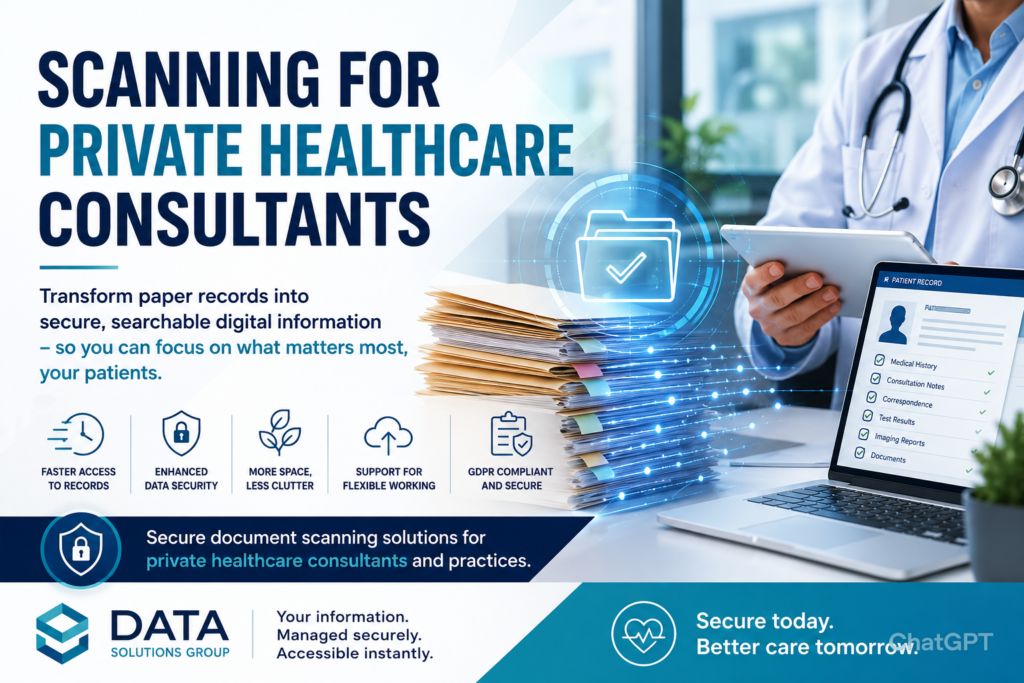
Document Scanning for Private Healthcare Consultants
Secure, Efficient and GDPR-Compliant Patient Record Management
Private healthcare consultants face increasing pressure to manage growing volumes of patient information while maintaining the highest standards of confidentiality, compliance and patient care. Although many practices have adopted digital systems, paper records, referral letters, consent forms and historical patient files often continue to occupy valuable office space and create administrative challenges.
Document scanning provides a practical solution, allowing private consultants to convert paper records into secure, searchable digital files that can be accessed instantly whenever required.
Why Private Healthcare Consultants Are Moving Away from Paper Records
Many consultants still rely on paper-based filing systems that have evolved over many years. While familiar, these systems can create several operational issues:
- Time spent locating patient records.
- Limited access to information when working remotely.
- Storage costs for archived files.
- Increased risk of misplaced documents.
- Difficulty sharing information securely with authorised colleagues.
- Compliance concerns relating to data protection regulations.
By digitising patient records, consultants can access information immediately, improve administrative efficiency and support better patient care. Digital records also make it easier to maintain comprehensive audit trails and document security controls.
The Benefits of Medical Records Scanning
Faster Access to Patient Information
When patient records are scanned and indexed correctly, authorised staff can retrieve information within seconds rather than searching through filing cabinets or archive boxes. This enables consultants to prepare for appointments more efficiently and respond to patient enquiries more quickly.
Improved Patient Care
Access to complete and organised patient records allows healthcare professionals to make informed decisions faster. Digital records help ensure that important clinical information, correspondence and historical notes are available when needed.
Enhanced Data Security
Patient records contain highly sensitive personal information and must be protected accordingly. Professional document scanning services utilise secure collection procedures, controlled scanning environments and strict handling protocols to maintain confidentiality throughout the digitisation process.
Better Use of Office Space
Many private practices dedicate valuable office space to storing historical patient files. Scanning these records enables consultants to reclaim storage areas for clinical or administrative use while maintaining instant access to information.
Support for Remote and Flexible Working
Modern healthcare increasingly requires access to records across multiple locations. Digital patient files can be integrated into existing document management systems, making authorised access easier for consultants and support staff.
What Records Can Be Scanned?
Private healthcare consultants typically hold a wide range of documentation suitable for digitisation, including:
- Patient medical records.
- Referral letters.
- Consultation notes.
- Consent forms.
- Diagnostic reports.
- Pathology results.
- Insurance documentation.
- Financial and billing records.
- Historical archive files.
- Large format medical charts and drawings.
GDPR and Patient Confidentiality
Compliance is a major concern for all healthcare providers. Patient records contain special category data under UK GDPR and therefore require robust security measures throughout their lifecycle.
When selecting a document scanning provider, consultants should ensure that appropriate procedures are in place for:
- Secure transportation of records.
- Controlled access to documents.
- Audit trails and chain of custody.
- Secure digital storage.
- Quality assurance processes.
- Confidential destruction of paper records where appropriate.
Healthcare organisations increasingly rely on professional scanning services to support information governance and maintain compliance with data protection requirements.
The Document Scanning Process
At Data Solutions Group, our healthcare document scanning process is designed to minimise disruption while ensuring the highest levels of security and quality.
1. Secure Collection
Patient records are collected using secure transport procedures and transferred directly to our scanning facility.
2. Document Preparation
Files are carefully prepared for scanning, with staples, clips and bindings removed where necessary.
3. High-Quality Scanning
Documents are scanned using professional production equipment to create clear, accurate digital images.
4. Indexing and Quality Control
Records are indexed according to your preferred criteria, such as patient number, surname, consultant name or reference number, making future retrieval simple and efficient.
5. Digital Delivery
Scanned files are supplied in a format suitable for your existing systems, including PDF, searchable PDF or other bespoke requirements.
6. Secure Storage or Destruction
Following approval, paper records can either be returned, securely stored or confidentially destroyed in accordance with your retention policies.
Why Choose Data Solutions Group?
Data Solutions Group provides secure document scanning services to healthcare organisations throughout the UK. We understand the importance of patient confidentiality, regulatory compliance and operational efficiency.
Our services are designed to help private healthcare consultants:
- Reduce administrative workloads.
- Improve access to patient information.
- Free valuable office space.
- Support GDPR compliance.
- Enhance patient service levels.
- Create a fully searchable digital archive.
Whether you are looking to digitise a few archive boxes or thousands of patient files, our experienced team can deliver a secure and cost-effective solution tailored to your practice.
Ready to Digitise Your Patient Records?
If your private healthcare practice is still relying on paper records, now is the ideal time to explore the benefits of document scanning. By converting paper files into secure digital records, consultants can improve efficiency, strengthen compliance and focus more time on delivering exceptional patient care.
Contact Data Solutions Group today to discuss your medical records scanning requirements and request a no-obligation quotation.
We also have further information regarding our NHS Clients HERE
Conclusion
Document Scanning for Private Healthcare Consultants: Secure, Efficient and GDPR-Compliant Patient Record Management
With Data Solutions Group, you can confidently move towards a secure, efficient, and fully digital document environment that supports the demands of modern healthcare.
👉 Contact Data Solutions Group today to discuss a tailored scanning and digital storage solution that keeps your business safe, compliant, and accessible.
📞 Call us on 01625 400250
📩 Or request a free consultation online
We help local authorities across the UK transform their archives into secure, efficient digital systems.
Data Solutions Group – Secure. Compliant. Trusted by Organisations Across the UK.