
Why ICO Registration Matters and Document Scanning
Secure Document Scanning and ICO Compliance
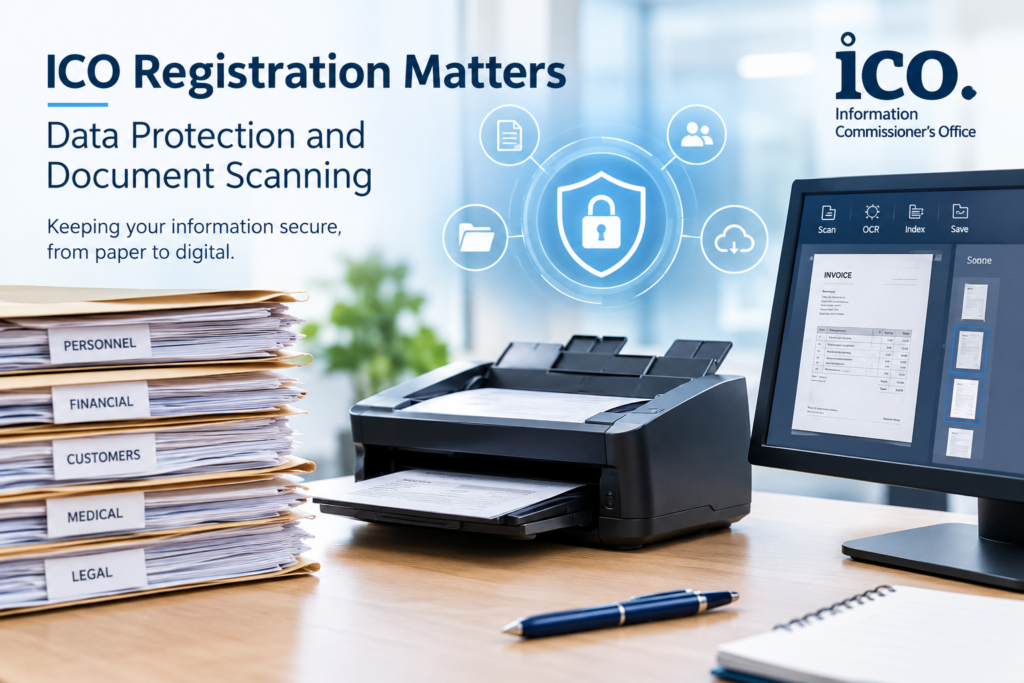
Why ICO Registration Matters and Document Scanning
When businesses outsource document scanning, they need confidence that their confidential information will be handled responsibly, this is Why ICO Registration Matters and Document Scanning. From employee personnel files and customer records to financial documents and medical information, paper archives can contain large amounts of sensitive personal data.
Choosing a document scanning company that takes information security seriously is therefore essential.
At Data Solutions Group, we recognise the importance of confidentiality, data protection and secure document handling. Understanding the role of the Information Commissioner's Office (ICO) is an important part of making informed decisions about how personal information is managed.
What Is the Information Commissioner's Office (ICO)?
The Information Commissioner's Office is the UK's independent regulator for information rights and data protection. It oversees relevant legislation, including the UK General Data Protection Regulation (UK GDPR) and the Data Protection Act 2018.
The ICO provides guidance to organisations on their responsibilities when collecting, storing, using and sharing personal information.
It also maintains a public register of organisations that have paid the applicable data protection fee, helping people check an organisation's registration details.
Organisations should assess whether they need to pay the ICO data protection fee. Some qualify for an exemption, depending on the nature of their activities and how they process personal information.
For further information, visit the official ICO website.
Why Does ICO Registration Matter and Document Scanning ?
Businesses regularly handle personal information belonging to employees, customers, suppliers and other individuals. Protecting this information is an important responsibility.
ICO registration, where required, demonstrates that an organisation has addressed its obligation to pay the relevant data protection fee. However, registration alone does not establish that an organisation complies with every aspect of data protection law.
Businesses must also consider how they collect, access, store, transfer, retain and dispose of personal information.
When selecting a document scanning provider, customers should therefore look beyond registration and consider the provider's practical security arrangements, confidentiality procedures and approach to information handling.
1. Protecting Confidential Information
Paper archives can contain commercially sensitive information and personal data that must be protected against unauthorised access or disclosure.
Examples include:
- Employee personnel files and employment contracts.
- Patient records and medical correspondence.
- Customer account information.
- Financial documents and invoices.
- Legal files and contractual agreements.
- School pupil records.
- Engineering and commercial project documentation.
A professional document scanning service should have appropriate procedures for handling these materials throughout the digitisation process.
2. Supporting Data Protection Responsibilities
The UK GDPR and Data Protection Act 2018 establish requirements for organisations that process personal information.
Depending on the circumstances, these include maintaining appropriate security, limiting access to authorised individuals and ensuring personal information is handled in accordance with applicable legal requirements.
When a business appoints an external scanning company, it should understand the responsibilities of each party.
In many outsourcing arrangements, the customer acts as the data controller and the scanning provider acts as a data processor. The precise roles depend on the activities undertaken.
Appropriate contractual arrangements, documented instructions and suitable security measures can help both parties manage their responsibilities.
3. Maintaining Confidentiality During Scanning
Document scanning involves more than converting paper into digital files. Original documents must be collected, transported, prepared, scanned and returned or securely destroyed in accordance with the agreed arrangements.
Businesses should consider how their scanning provider protects documents at every stage.
Important considerations include:
- Secure collection and transportation.
- Controlled access to documents and scanning areas.
- Confidential handling procedures.
- Appropriate quality-control checks.
- Secure electronic file transfer.
- Clear arrangements for returning or destroying originals.
These measures help businesses assess whether a scanning provider is suitable for handling confidential records.
How Does Data Protection Apply to Document Scanning?
Digitising paper archives can make information easier to retrieve and manage. However, scanning personal information does not remove the need to protect it.
Businesses should consider data protection throughout the project.
Secure Collection and Transportation
Archived documents may contain sensitive personal, financial or commercial information. Collection and transportation arrangements should reflect the sensitivity and volume of the records.
Customers should understand how their documents will be handled and what measures are in place to protect them during transit.
Scanning and Quality Control
Scanning should produce clear, usable digital images that meet the customer's requirements.
Quality-control procedures can help identify problems such as missing pages, incorrect orientation, poor image quality or incomplete files.
Where required, OCR can make scanned documents searchable, while indexing can help users locate individual records quickly.
Secure Electronic Delivery
Once documents have been digitised, the resulting files must be delivered through an appropriate method.
Depending on the project, this may involve an encrypted storage device, a secure download link or an agreed electronic document platform.
The delivery method should reflect the customer's security requirements and the sensitivity of the information.
Retention and Confidential Destruction
After scanning, customers must decide what should happen to the original paper records.
Some documents need to be retained for legal, regulatory or operational reasons. Others may be eligible for confidential destruction under an authorised retention policy.
Originals should not be destroyed simply because they have been scanned. The customer should first establish that destruction is appropriate and explicitly authorise it.
Where confidential destruction is agreed, the arrangements should be clearly documented.
Why Choose Data Solutions Group?
At Data Solutions Group, we understand that businesses need more than scanned images. They need a dependable service that handles their records carefully and produces digital files that are practical to use.
We provide document scanning services for organisations across the UK, helping businesses convert paper archives into accessible digital records.
Our services can include:
- Secure document collection: Arrangements designed to protect original records during transportation.
- Professional document preparation: Handling paperwork carefully before scanning.
- High-quality scanning: Standard scanning at 300 dpi, with colour scanning available where required.
- OCR and searchable PDFs: Making suitable scanned documents easier to search and retrieve.
- Document indexing: Naming and organising files using agreed references, names or document types.
- Quality checking: Checking scanned images to help ensure that the finished files meet the agreed requirements.
- Secure electronic delivery: Providing digital files through an agreed delivery method.
- Confidential destruction: Arranging the destruction of original documents where authorised by the customer.
We can also discuss phased projects for organisations that need to digitise substantial archives over several months.
Our approach is built around three important values: Confidentiality, Quality and Integrity.
We understand that every archive is different. For that reason, we discuss the customer's requirements before agreeing on the appropriate scanning, indexing, delivery and retention arrangements.
ICO Registration and Customer Confidence
When choosing a document scanning provider, customers should consider the provider's ICO registration status where applicable, alongside its practical information security arrangements.
It is important to understand that ICO registration is not the same as a certification of information security or a guarantee of compliance with every data protection requirement.
Customers should also consider:
- The provider's confidentiality procedures.
- How access to original documents is controlled.
- The security of electronic file transfers.
- The handling of sensitive or special-category personal data.
- The arrangements for retaining and destroying original documents.
- The contractual responsibilities of the scanning provider.
- The procedures for managing potential data breaches.
Taking these factors into account helps businesses make a more informed decision when outsourcing the digitisation of confidential records.
Frequently Asked Questions
What does ICO stand for?
ICO stands for the Information Commissioner's Office, the UK's independent regulator for information rights and data protection.
Does every business need to register with the ICO?
Not necessarily. Organisations should complete the ICO's data protection fee self-assessment to establish whether they need to pay the fee or qualify for an exemption.
Does ICO registration mean a company is GDPR compliant?
No. ICO registration or payment of the data protection fee does not, by itself, demonstrate full compliance with the UK GDPR or Data Protection Act 2018. Organisations must meet the legal requirements that apply to their activities.
Why is data protection important when scanning documents?
Document archives can contain personal, financial, medical and commercially sensitive information. Appropriate security measures help protect this information during collection, preparation, scanning, delivery, retention and destruction.
Can businesses securely destroy original documents after scanning?
Yes, where destruction is appropriate and has been authorised. Businesses should first consider applicable retention requirements and ensure that original records are not destroyed prematurely.
How can I choose a secure document scanning company?
Ask about the provider's confidentiality procedures, collection arrangements, access controls, quality checks, electronic delivery methods and destruction processes. You should also establish the contractual responsibilities of both parties.
Speak to Data Solutions Group About Secure Document Scanning
If your organisation holds large quantities of paper records, digitisation can make information easier to access, search and manage.
Data Solutions Group provides document scanning services tailored to the needs of businesses and organisations across the UK.
Whether you need to digitise personnel files, financial records, medical documentation, engineering drawings or an extensive archive, we can discuss your requirements and recommend a suitable approach.
Contact Data Solutions Group to discuss your document scanning project and request a quotation.
Call us on 01625 400250 or use our online enquiry form to request a quotation.
Data Solutions Group Ltd — Professional Document Scanning Services Across the UK.
💬 Request a Free Quote Online — we’re happy to arrange a consultation or site visit.