
The History of Document Scanning
The History of Document Scanning
For decades, organisations relied entirely on paper to store their most important information. Filing cabinets, archive rooms and off-site storage were once the backbone of every business. However, as companies grew and regulations tightened, the need for faster, safer and more efficient document management became impossible to ignore.
Document scanning didn’t appear overnight — it evolved alongside technology, regulation and the increasing value of data.
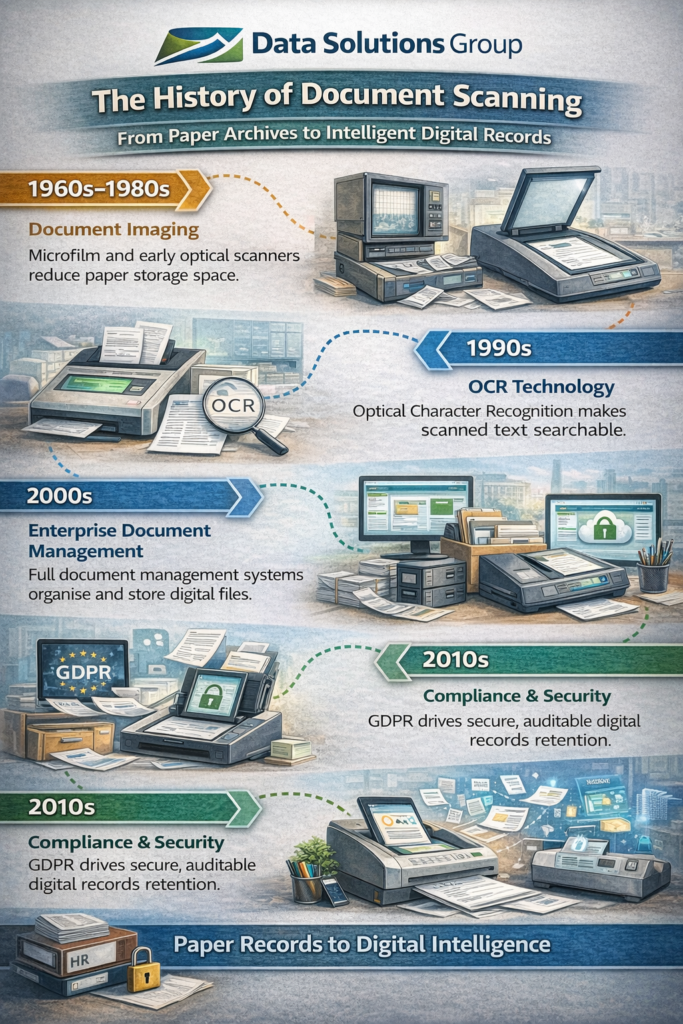
The History of Document Scanning
The Paper Era – Before Digital Records
Before the 1960s, all business records were paper-based. HR files, invoices, engineering drawings and legal documents were stored in physical folders and warehouses. While this system worked, it came with major problems:
-
Files were easy to lose
-
Storage costs kept growing
-
Retrieval was slow
-
Fire, flood and theft were constant risks
As businesses expanded, so did their archives — and something had to change.
The Birth of Document Imaging (1960s–1980s)
The first step toward scanning began with microfilm and microfiche. Documents were photographed and stored on film, dramatically reducing physical storage space. Banks, government bodies and libraries were among the first to adopt it.
However, microfilm was difficult to search and required special equipment to view. As computers became more common in the 1980s, engineers began exploring ways to convert paper directly into digital images.
This led to the first optical scanners — slow, bulky devices that could convert paper into digital images, though without searchable text.
The Rise of OCR Technology (1990s)
The real breakthrough came with Optical Character Recognition (OCR). Instead of just creating an image, OCR allowed computers to read the text inside a document.
This meant businesses could now:
-
Search inside documents
-
Copy and extract data
-
Automate indexing
Banks, hospitals and legal firms quickly realised the value. Instead of manually searching through boxes of paper, staff could find documents in seconds.
Enterprise Document Management (2000s)
As storage became cheaper and software more powerful, document scanning evolved into full document management systems (DMS).
Organisations began scanning:
-
HR files
-
Accounts payable invoices
-
Engineering drawings
-
Contracts and legal records
At the same time, regulations such as Data Protection, ISO standards and financial compliance rules made digital records far more attractive than paper. Digital files were easier to back up, audit and protect.
The Compliance & Security Era (2010s)
The introduction of GDPR and stricter data protection laws changed everything.
Businesses were now required to:
-
Control who could access data
-
Track document usage
-
Apply retention schedules
-
Securely delete records when required
As a result, professional document scanning and indexing became essential. Simply scanning wasn’t enough — organisations needed secure, auditable and legally compliant digital records.
This is where companies like Data Solutions Group play a vital role — providing scanning that meets BS 10008, ISO 9001, and GDPR standards.
Modern Document Scanning Today
Today, document scanning is no longer just about digitising paper. It’s about creating intelligent information systems.
Modern scanning includes:
-
High-resolution image capture
-
Advanced OCR and data extraction
-
Automated indexing
-
Secure cloud storage
-
Retention and destruction controls
From HR departments to manufacturing firms and housing associations, organisations now use scanning to streamline workflows, reduce risk and improve compliance.
What the Future Holds
The future of document scanning is moving toward:
-
AI-powered data extraction
-
Automated classification
-
Predictive document retention
-
Real-time compliance monitoring
However, the foundation remains the same: converting physical records into secure, reliable digital data.
How Data Solutions Group Fits In
At Data Solutions Group, we bring together decades of scanning expertise with modern compliance, security and digital workflows. We help organisations move from paper chaos to digital control — safely, legally and efficiently.
Whether you’re scanning HR files, finance records or technical drawings, we ensure your data is:
-
Secure
-
Searchable
-
Compliant
-
Future-proof
👉 Contact Data Solutions Group today to discuss a tailored scanning and digital storage solution that keeps your business safe, compliant, and accessible.
📞 Call us on 01625 400250
📩 Or request a free consultation online
We help local authorities across the UK transform their archives into secure, efficient digital systems.
Data Solutions Group – Secure. Compliant. Trusted by Organisations Across the UK.