
The History of Microfilm
The History of Microfilm
The First Step Toward Digital Records
Long before scanners, cloud storage and OCR software existed, organisations still faced one big problem: too much paper. Governments, banks, libraries and businesses were drowning in documents, yet they had no reliable way to store them efficiently.
The solution was microfilm — the technology that laid the foundation for modern document scanning.
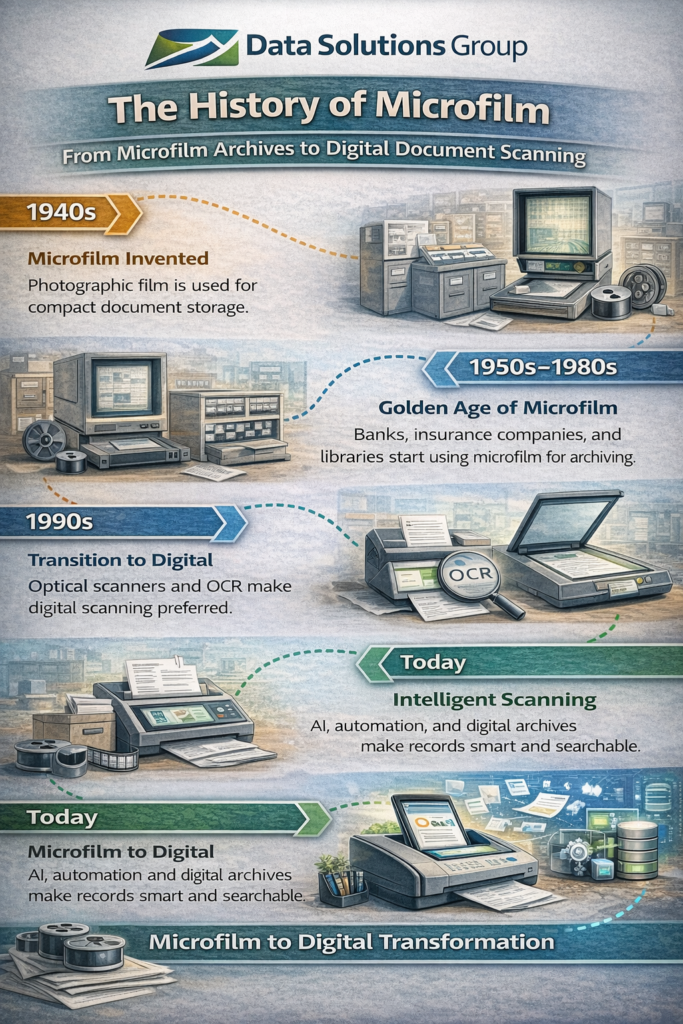
The History of Microfilm
What Is Microfilm?
Microfilm is a photographic method of storing documents on film at a reduced size. A single reel of film could hold thousands of pages, which could later be viewed, printed or enlarged using special readers.
At the time, this was revolutionary:
-
It reduced storage space by up to 95%
-
It preserved fragile documents
-
It allowed records to be duplicated and archived
In many ways, microfilm was the first true form of document imaging.
The Origins of Microfilm (1920s–1940s)
Microfilm was first developed in the early 20th century, but it became widely used during World War II. Governments needed a way to:
-
Store sensitive documents securely
-
Transport large volumes of records
-
Protect information from destruction
Libraries also adopted microfilm to preserve rare books, newspapers and historical records that were deteriorating on paper.
The Golden Age of Microfilm (1950s–1980s)
By the 1950s, microfilm had become the standard for archiving in:
-
Banks
-
Insurance companies
-
Courts
-
Hospitals
-
Government departments
Entire filing rooms were replaced by cabinets of film reels. Auditors and administrators could retrieve records faster than paper, and storage costs dropped dramatically.
For decades, microfilm was seen as the most secure and reliable way to store critical documents.
The Limitations of Microfilm
Despite its success, microfilm had serious drawbacks:
-
It could not be searched by text
-
Users needed special readers
-
Copies degraded over time
-
Sharing information was slow
-
Indexing was manual
As businesses became more data-driven, these limitations became more obvious.
The Transition to Digital Scanning (1990s)
When optical scanners and OCR became available in the 1990s, organisations finally had a better alternative. Unlike microfilm, digital documents could be:
-
Fully searchable
-
Instantly shared
-
Backed up automatically
-
Stored in multiple locations
Many organisations began converting their microfilm archives into digital formats — a process still happening today.
Microfilm in the Modern World
Although digital systems now dominate, microfilm has not disappeared. It is still used for:
-
Long-term government archives
-
Legal and historical preservation
-
Disaster recovery storage
In fact, properly stored microfilm can last over 500 years, making it one of the most stable archival formats ever created.
How Microfilm Led to Modern Document Scanning
Microfilm proved something vital:
documents don’t have to live on paper to be safe or usable.
Today’s scanning, OCR and digital archiving systems are simply the next evolution of the same idea — storing information in a smaller, safer, smarter format.
How Data Solutions Group Supports Legacy Archives
At Data Solutions Group, we help organisations:
-
Convert microfilm to digital formats
-
Scan legacy paper archives
-
Apply OCR and indexing
-
Create fully compliant digital records
This allows decades of information to be unlocked, searched and secured for the future.
👉 Contact Data Solutions Group today to discuss a tailored scanning and digital storage solution that keeps your business safe, compliant, and accessible.
📞 Call us on 01625 400250
📩 Or request a free consultation online
We help local authorities across the UK transform their archives into secure, efficient digital systems.
Data Solutions Group – Secure. Compliant. Trusted by Organisations Across the UK.